Job Listings
Showing posts with label visit Indonesia year 2009. Show all posts

We (Bali) are always welcome for the tourists

>> Friday, 23 October 2009

Visit Indonesia Year(s)
Government to Retain VIY for Third Year in Effort to Woo 7 Million Visitors in 2010.

Bali News: Visit Indonesia Year(s)
(10/23/2009) Indonesia's Department of Culture and Tourism has announced its intention to continue the current Visit Indonesian Year (VIY) campaign for a third year as part of plans to attract 7 million foreign visitors in 2010.

Sunrise, Sunset, One Season Following Another

Visit Indonesia Year which was initially launched after 2008 was already well underway, was retained for an additional year in 2009. The latest announcement from the government is that the program will be retained for a third year - 2010. Credited with bringing 6.4 million visitors to Indonesia in 2008, tourism officials remain confident that VIY 2010 will pave the way for modest growth in tourism arrivals while arrivals to competing destinations in the region continue to shrink.

Tourism officials also point to Indonesia's improving security situation as contributing to tourism growth now that violence-prone fundamentalist elements are being arrested, run to ground or physically eliminated.

Sapta Nirwandar, the Director General of Marketing at the Department of Culture and Tourism, told the Bali Post that suggestions are under consideration to drop the "year tag line" and just retain "Visit Indonesia."

Critics of the retention of VIY for a third year believe the program's message may be losing its potency and its continued retention underline a fundamental lack of creativity in how the country's tourism is promoted.

In 2008, Indonesia welcomed 6.4 million foreign tourist who spent an estimated US$7.5 billion in foreign exchange. Indonesia expects more than 6.5 million foreign tourists in 2009. 
 
Source: http://balidiscover.com
Read More >>

I miss Bali's old fashion

Four Nights of Classic Balinese Cinema in Ubud
A Four-Night Celebration of Balinese Dance on Film by the Amandari Resort, Sayan, Ubud, October 14-17, 2009.

Bali News: Four Nights of Classic Balinese Cinema in Ubud (10/16/2009) As part of its celebration of 20 years of operation, Bali's Amandari in Sayan, Ubud, is hosting 4 nights of classic Balinese cinema presented at the Wantilan - Pura Desa Kedewatan October 14-17, 2009.

Presented in cooperation with Cinematheque De La Dance in Paris and The French Embassy in Jakarta, the showings are without charge with a cash bar available. Each film performance begins at 7:00 p.m. sharp.

Classic Balinese Cinema at The Amandari

Wednesday, October 14, 2009 - Schonheit und Reichtung – The Life of Walter Spies (1986) by H. Hulscher and Bali (1933) by Rolf de Mare. Stunningly beautiful and rare footage of Balinese dance with some sequences actually shot by the legendary Walter Spies.

Thursday, October 15, 2009 - Island of Demons (1933) by Victor Von Plessen and Walter Spies. This story is loosely inspired by the legend of the Calonarang. Dances staged by Walter Spies.

Friday, October 16, 2009 - Trance and Dance in Bali (1938) by Margaret Mead and Gregory Bateson. This is an early filming of what is known today as the ‘Keris Dance.” Legong – Island of the Virgins (1935) by Henry de la Falaise. An unrequited and tragic love story between two Balinese youth.

Saturday, October 17, 2009 - Strangers in Paradise (2008) – A travel diary by a lover of Balinese Dance, from the seventies up to the present day. Colin McPhee: The Lure of Asian Music (1985) by Michael Blackwood. The life and work of Colin McPhee, author of Music of Bali and A House in Bali.
Read More >>

Balinese Gamelan

>> Wednesday, 7 October 2009

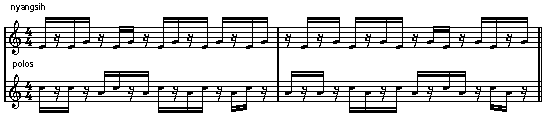
A gamelan  is an ensemble normally composed primarily of percussion. In Bali, orchestras of tuned gongs, bronze kettles, bronze metallophones, bamboo xylophones, drums, cymbals and flutes fill the night air with animated music. Melodic parts interlock, divided in such a way that musicians play alternate notes to form the melody line. These interlocking parts, known as kotèkan,  require cooperation and a keen sense of rhythm to perform. The two parts of a kotèkan, which are thought of as male and female, are known as nyangsih  and polos.  The main accents of the nyangsih part are usually on the offbeat, while the main accents of the polos part are usually on the beat.
Knowledge of kotèkan can be extremely valuable. These interlocking rhythms have a unique way of bringing people together in cooperation towards a common goal, and there are many creative possibilities for applying them to contemporary music.
The book Ancient Traditions--Future Possibilities, by Matthew Montfort, contains exercises that teach these rhythms. Some of these exercises are adapted here for the World Wide Web.

Using MIDI

GM Standard MIDI files of Balinese rhythm exercises from the book are presented here, arranged for General MIDI vibraphones. Use this to practice Balinese interlocking parts, or for compositional ideas.
Computers with multimedia capabilities now come configured for MIDI playback via web browsers. However, with the built-in MIDI support in Netscape and Explorer, some files may not reproduce properly. For proper playback, this site recommends the Beatnik Plugin which supports both GM voices and user programmable sounds.
To set up playback on a MIDI sound module that is not GM compatible, see the MIDI map of the instruments of the Balinese gamelan.

Balinese Rhythm Exercises

Gong IconKotèkan Basics is a beginning exploration of the art of interlocking parts. Includes complete instructions, notation, and a MIDI file. A beginning level example from Ancient Traditions--Future Possibilities, Chapter 2, Exercise II, page 49.
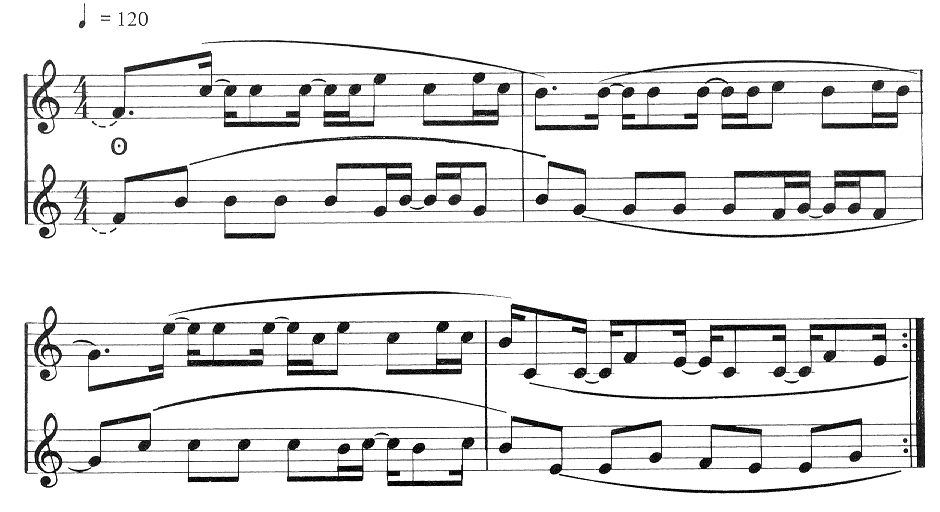
Gong IconAnklung MIDI file is an intermediate level Gamelan Anklung kotèkan from Ancient Traditions--Future Possibilities, Chapter 2, Exercise III D, page 51. This kotèkan was used as the basis for the composition Gamarock from the Ancient Future release Dreamchaser. More examples of the contemporary use of the kotèkan concept can be found in the Ancient Future introductory pages theme music (from World Without Walls).
Link to Balinese Gamelan Notation(3K GIF of Anklung  in Music Notation)
Gong IconPèrmas MIDI File is an advanced level example of the composition Pèrmas  from the repertoire of the Gamelan Semar Pegulingan,  the "gamelan of the love God," as shown in Ancient Traditions--Future Possibilities, Chapter 2, Exercise V-B, page 54.

Link to Balinese Gamelan Notation(107K GIF of Pèrmas  in Music Notation)
Gong IconAncient Rhythms--Future Grooves: MIDI Percussion Groove Tracks from the Traditions of Africa, Bali, and India. Want more MIDI files? Get this complete collection of MIDI files based on the book Ancient Traditions--Future Possibilities.
Read More >>

About This Blog

Lorem Ipsum

A Beautiful Rice Field in Bali

A Beautiful Rice Field in Bali

  © Blogger templates Palm by Ourblogtemplates.com 2008

Back to TOP