Job Listings

1927- Walter Spies

>> Wednesday, 7 October 2009


In almost everybody’s opinion, Walter Spies was the greatest and certainly the most flamboyant painter to live in Bali, Where his name has become a legend. Born is Russia to the parents of German diplomats, Spies was both a brilliant artist and musician. At the early age he was thrown into the creative maelstrom of the pre-second world war German avant gerde movement. Lover of the great German director, Fritz Murnau, Spies was in close contact with Otto Dix and Oskar Kokoschka, both who influenced his painting. In a letter to his father in 1919 he writes that he wishes to free himself of indoctrination and prejudices about taste and beauty and paint freely like a child with the skill of Chagall and Klee. Bali was to give him the freedom to realize his wish.spies1.jpg (9543 bytes)Walter Spies was born on 14 Sep 1898, so he was about 25 years old when he came to Indonesia in 1923, and about 29 years old when he moved to Bali in 1927.In almost everybody's opinion, Walter Spies was the greatest and certainly the most flamboyant painter to live in Bali, where his name has become a legend. Born in Russia in 1898, where his father Leon was a German diplomat, Spies was both a brilliant artist and musician. After World War I, he was thrown into the creative maelstrom of the Weimar Republic, embracing the German artistic avant-garde. Lover of the great German film director, Frederich Murnau, Spies was in close contact with Otto Dix and Oskar Kokoschka, who both influenced his painting. In a letter to his father in 1919, Walter writes that he wishes to free himself of indoctrination and prejudices about taste and beauty and paint freely like a child, with the skill of Chagall and Klee. Bali was to give him the freedom to realize his wish.

The young, handsome Spies first traveled to Indonesia in 1923 at 25 years of age, in part to flee the grasp of the older and very possessive Murnau. He finally settled in Bali in 1927, where he created his best canvases during the 14 years he spent on the island. Often called a surrealist for the dream-like quality of his paintings, Spies' works combine a rich and fluid imagination mingled with Balinese scenes and myths. While a great painter, his production was limited as he was always busy with countless other projects, such as supporting local arts and artists and co-authoring books on dance and drama. As Bali's most famous European resident in the 1930s, he entertained such luminaries as Charlie Chaplin and conductor Leopold Stokowski, some of whom bought his works.

Persecuted as a homosexual, he was helped by Margaret Mead and her husband Gregory Bateson, who testified that his 'transgressions' were not inconsistent with Balinese culture. He was deported with others as a prisoner in 1942 for holding a German passport. The ship was bombed, and, as the ship slowly sank, the prisoners perished in their locked cells, because the captain declined to free them. Walter's tragic death has only added to his romantic myth.

There is one painting attributed to Spies on the island at the Agung Rai Gallery. One of his best, from the collection of Dutch heiress, Marianne van Wessum, just sold at auction in The Hague for over
$500,000.
Read More >>

some of the foreign artists in Bali 1904 - 1967


1904-W.O.J. Nieuwenkamp.The first artist to visit Bali. Born in Amsterdam in 1876, Nieuwenkamp’s nickname was the "Wanderer". He came not only to make his own art but to learn Balinese traditional painting. A multi-faceted autodidact,The first artist to visit Bali. Born in Amsterdam in 1876, Nieuwenkamp’s nickname was the "Wanderer". He came not only to make his own art but to learn Balinese traditional painting. A multi-faceted autodidact, W.O.J. was more a graphic artist than a painter. The first artist to visit Bali. Born in Amsterdam in 1876, Nieuwenkamp’s nickname was the "Wanderer". He came not only to make his own art but to learn Balinese traditional painting. A multi-faceted autodidact, W.O.J. was more a graphic artist than a painter.He returned to Bali many times over the years and authored the most important early book on the island Bali en Lombok (1906-1910), which includes pioneering ethnographic and archaeological studies. Working primarily in ink, his drawings are executed in rich sepia tones. The influence of Art Nouveau on his work is clear though he did not strictly belong to that movement. His large body ofwoj1.jpg (18463 bytes) workon Bali and Indonesia, which includes nearly one thousand delightful drawings and paintings,is virtually unknown. He played a critical role in creating the myth of Bali, most importantly through his support of the German doctor and amateur photographer, Gregor Krauser. Together they held the first exhibition of Balinese Art in Amsterdam in 1918 with Krauser’s photos and Nieuwenkamp ’s drawings. It is Krauser’s later book which brought many of the artists mentioned in this article to Bali.
Read More >>

Bali's Geography

In one of beautiful beach in Bali

WHERE IS BALI?

The island of Bali is part of the Republic of Indonesia and is located 8 to 9 degrees south of the equator between Java in the West and Lombok and the rest of the Lesser Sunda Islands (Sumbawa, Flores, Sumba and Timor) in the East. Flying time to Jakarta is about 1.5 hours, to Singapore and Perth (Australia) 2.5 and 3 hours, to Hong Kong about 4.5 hours, and to Sydney/Melbourne about 5.5 to 6 hours.

GEOGRAPHY:

The island of Bali has an area of only 5,632 square kilometers (2,175 square miles) and measures just 55 miles (90 kilometers) along the north-south axis and less than about 90 miles (140 kilometers) from East to West. Because of this it's no problem to explore the island on day tours. You can go wherever you want on the island and return to your hotel or villa in the evening.
Located only two kilometers east of Jawa, Bali's climate, flora and fauna are quite similar to its much larger neighbour. The island is famous for its beautiful landscape. A chain of six volcanoes, between 1,350 meters and 3,014 meters high, stretches from west to east. There are lush tropical forests, pristine crater lakes, fast flowing rivers and deep ravines, picturesque rice terraces, and fertile vegetable and fruit gardens. The beaches in the South consist of white sand, beaches in other parts of the island are covered with gray or black volcanic sand.

FLORA:

The wide variety of tropical plants is surprising. You'll see huge banyan trees in villages and temple grounds, tamarind trees in the North, clove trees in the highlands, acacia trees, flame trees, and mangroves in the South. In Bali grow a dozen species of coconut palms and even more varieties of bamboo.
And there are flowers, flowers everywhere. You'll see (and smell the fragrance of) hibiscus, bougainvillea, jasmine, and water lilies. Magnolia, frangipani, and a variety of orchids are found in many front yards and gardens, along roads, and in temple grounds. Flowers are also used as decorations in temples, on statues, as offerings for the gods, and during prayers. Dancers wear blossoms in their crowns, and even the flower behind the ear of your waitress seems natural in Bali.

FAUNA:

Elephants and tigers don't exist any more in Bali since early this century. Wildlife, however, includes various species of monkeys, civets, barking deer and mouse deer, and 300 species of birds including wild fowl, dollar birds, blue kingfishers, sea eagles, sandpipers, white herons and egrets, cuckoos, wood swallows, sparrows, and starlings. You can watch schools of dolphins near Lovina, Candi Dasa, and Padangbai. Divers will see many colorful coral fish and small reef fish, moray eels, and plankton eating whale sharks as well as crustaceans, sponges, and colorful coral along the east coast and around Menjangan Island near Gilimanuk.

CLIMATE:

You can expect pleasant day temperatures between 20 to 33 degrees Celsius or 68 to 93 degrees Fahrenheit year-round. From December to March, the West monsoon can bring heavy showers and high humidity, but usually days are sunny and the rains start during the night and pass quickly. From June to September the humidity is low, and it can be quite cool in the evenings. During this time of the year, you'll have hardly any rain in the coastal areas.
Even when it rains in most parts of Bali you can often enjoy sunny days on the "Bukit", the hill south of Jimbaran Beach. On the other hand, in Ubud and the mountains you must expect cloudy skies and showers throughout the year (this is why the international weather reports for "Denpasar" or "Bali" mention showers and rain storms during all times of the year). In higher regions such as in Bedugul or Kintamani you'll also need either a sweater or jacket after the sun sets.

POPULATION:

Bali's population has grown to over 3 million people the overwhelming majority of which are Hindus. However, the number of Muslims is steadily increasing through immigration of people from Java, Lombok and other areas of Indonesia who seek work in Bali.
Most people live in the coastal areas in the South, and the island's largest town and administrative center is fast growing Denpasar with a population of now over 370,000. The villages between the town of Ubud and Denpasar, Kuta (including Jimbaran, Tuban, and Legian, Seminyak, Basangkasa, etc), Sanur, and Nusa Dua are spreading rapidly in all directions, and before long the whole area from Ubud in the North to Sanur in the East, Berawa/Canggu in the West, and Nusa Dua in the South will be urbanized.

ECONOMY:

This southern part of Bali is where most jobs are to be found, either in the hotel and tourist industry, the textile and garment industry, and in many small scale and home industries producing handicrafts and souvenirs. Textiles, garments, and handicrafts have become the backbone of Bali's economy providing 300,000 jobs, and exports have been increasing by around 15% per year to over US$400 million. Textiles and garments contribute about 45%, and wood products including statues, furniture and other handicrafts 22% to the province's total income from exports. Silver work is ranked third (4.65%) with 5,000 workers employed. Main buyers are the US and Europe with 38% each, and Japan with 9%.
Important agricultural products besides rice are tea, coffee, tobacco, cacao, copra, vanilla, soy beans, chilies, fruit, and vegetable (there are now even vineyards near the northwest coast). Bali's fishing industry and seaweed farming provide other products which are important exports.
The new free-trade regulations will create some problems for Bali's exporters as they do not allow to employ children. Most children here work for their parents, and this is part of the process of acquiring professional skills and kind of an informal education which has been very important in the Balinese society for centuries.

WHAT MAKES BALI SO SPECIAL:

There is the combination of the friendly people, the natural attractions, the great variety of things to see and do, the year-round pleasant climate, and the absence of security problems. And then there is Bali's special "magic", which is difficult to explain.
As soon as you step off the plane you might sense the difference. In the villages you'll notice the quietness and wisdom in old people's faces, and the interest and respect in the young's. Old men sit at the road side caressing their fighting cocks. Beautifully dressed women walk proudly through rice fields and forests carrying offerings on their heads to the next temple. There is the smell of flowers, and in the distance you hear the sound of gamelan music.
Gods and spirits have been an important part of Bali's daily life for hundreds of years. Gunung Agung – Bali's holy mountain – is internationally regarded as one of the eight "Chakra" points of the world. This may be more than an coincident. Watch out, the moment you feel the magic of this island, you're addicted for the rest of your life.

NB: in many sources
Read More >>

Bali map

Read More >>

Balinese Gamelan

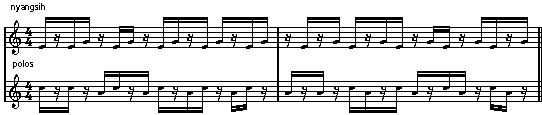
A gamelan  is an ensemble normally composed primarily of percussion. In Bali, orchestras of tuned gongs, bronze kettles, bronze metallophones, bamboo xylophones, drums, cymbals and flutes fill the night air with animated music. Melodic parts interlock, divided in such a way that musicians play alternate notes to form the melody line. These interlocking parts, known as kotèkan,  require cooperation and a keen sense of rhythm to perform. The two parts of a kotèkan, which are thought of as male and female, are known as nyangsih  and polos.  The main accents of the nyangsih part are usually on the offbeat, while the main accents of the polos part are usually on the beat.
Knowledge of kotèkan can be extremely valuable. These interlocking rhythms have a unique way of bringing people together in cooperation towards a common goal, and there are many creative possibilities for applying them to contemporary music.
The book Ancient Traditions--Future Possibilities, by Matthew Montfort, contains exercises that teach these rhythms. Some of these exercises are adapted here for the World Wide Web.

Using MIDI

GM Standard MIDI files of Balinese rhythm exercises from the book are presented here, arranged for General MIDI vibraphones. Use this to practice Balinese interlocking parts, or for compositional ideas.
Computers with multimedia capabilities now come configured for MIDI playback via web browsers. However, with the built-in MIDI support in Netscape and Explorer, some files may not reproduce properly. For proper playback, this site recommends the Beatnik Plugin which supports both GM voices and user programmable sounds.
To set up playback on a MIDI sound module that is not GM compatible, see the MIDI map of the instruments of the Balinese gamelan.

Balinese Rhythm Exercises

Gong IconKotèkan Basics is a beginning exploration of the art of interlocking parts. Includes complete instructions, notation, and a MIDI file. A beginning level example from Ancient Traditions--Future Possibilities, Chapter 2, Exercise II, page 49.
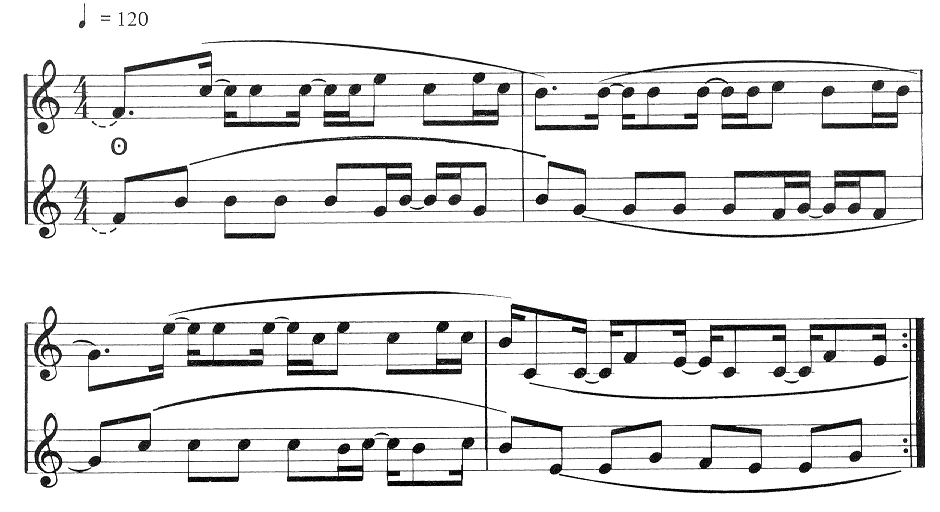
Gong IconAnklung MIDI file is an intermediate level Gamelan Anklung kotèkan from Ancient Traditions--Future Possibilities, Chapter 2, Exercise III D, page 51. This kotèkan was used as the basis for the composition Gamarock from the Ancient Future release Dreamchaser. More examples of the contemporary use of the kotèkan concept can be found in the Ancient Future introductory pages theme music (from World Without Walls).
Link to Balinese Gamelan Notation(3K GIF of Anklung  in Music Notation)
Gong IconPèrmas MIDI File is an advanced level example of the composition Pèrmas  from the repertoire of the Gamelan Semar Pegulingan,  the "gamelan of the love God," as shown in Ancient Traditions--Future Possibilities, Chapter 2, Exercise V-B, page 54.

Link to Balinese Gamelan Notation(107K GIF of Pèrmas  in Music Notation)
Gong IconAncient Rhythms--Future Grooves: MIDI Percussion Groove Tracks from the Traditions of Africa, Bali, and India. Want more MIDI files? Get this complete collection of MIDI files based on the book Ancient Traditions--Future Possibilities.
Read More >>

Brata I Homestay

>> Monday, 5 October 2009

Read More >>

UBUD WRITERS & READERS FESTIVAL '09

>> Sunday, 4 October 2009

Suka Duka : Compassion and Solidarity
7 October – 11 October 2009

The established will meet the new.
The East will cross paths with the West.
It will be a literary celebration like no other.

This year’s Ubud Writers & Readers Festival promises to be as exciting as ever. Our 2009 theme Suka-Duka: Compassion & Solidarity.
Suka Duka is an ancient communal wisdom that for centuries has been one of the main pillars of Bali’s traditional institutions and communities. The principle has guided the members of the traditional institutions, such as banjar (neighbourhood organisations) and desa pakraman (customary villages), to act as one single entity in dealing with life’s hardships and blessings. The suffering of one member will be shouldered by all, while the joy of one will be shared by the other.
The theme reflects the Festival’s commitment to turn this literary gathering into an inspiring moment, through which writers and readers from every corner of the world can establish a mutual understanding as well as a common platform to remind the world of the need to think and act as one single, compassionate entity, particularly during this epoch of violent conflicts and social turmoil.
Linger over a literary lunch or candle-lit dinner in some of Ubud’s elegant hotels and gracious homes featuring our acclaimed writers and visiting chefs. Enjoy poetry under the shade of a Buddhist stupa and late night martinis and readings in one of Ubud’s legendary bars. Be dazzled by some of the finest performance poets in the region in grass-roofed venues surrounded by ricefields. Watch plays and theatre in Ubud’s temples set in frangipani and lotus gardens.
Join workshops that teach the craft of writing, in between book launches, performances, exhibitions, cocktail parties and celebrations into the early hours of the morning.
And if that is not enough, the 2009 Festival will take to the streets once again with a dazzling carnival of poetry and performance in one of Ubud’s charming laneways.
Is it any wonder we are named ‘one of the six best literary festivals in the world!’
Read More >>

>> Friday, 2 October 2009


Galungan Day
The victory Dharma(virtue) from Adharma (evil)

Host: BALI

Type: Other - Festival

Network: Global
Date: Wednesday, 14 October 2009
Time: 00:00 - 12:00
Location: Bali Island
Description
The day commemorated as the victory day of "Dharma" (virtue) upon "Adharma" (evil) according to the old history of Bali (Purana). This day the Hindus thanks the God and feel grateful for His blessing and for the creation of the earth and its contents. This day is the day of rituals, festivities and celebrations with "Penjor" the artistically decorated bamboo-pole stuck at every house entrance, adorning the both sides of the village-roads symbolizing of prosperity.
There are several processions need to be done to celebrate Galungan Day:
PENYEKEBAN ( 3 days before Galungan - 11 oct 2009 )
On this day, people begin to prepare the necessities for the Galungan ceremony. They collect fruits and store them in a special place until they get ripe.
 PENYAJAHAN (2 days before Galungan - 12 oct 2009 )
On Penyajahan day, people keep on maintaining awareness, patience and the purity of the soul in order to control the demons. Another meaning of Penyajahan is making or cooking Balinese cakes (jaja). Therefore, on this day, people have to cook various kinds of Balinese cakes for the ceremony to come.
PENAMPAHAN (13 oct 2009 )
This is a sacrificial day. This is the day to slaughter sacrificial animals like chickens, ducks or pigs. People cook them into various kinds of Balinese food, such as satay, soup, lawar (a special Balinese food made of meat or vegetables, mixed with coconut sauce).While the women continue to be kept busy with the preparations of the many offerings to be made at the temple on the day of Galungan,The man also make A long bamboo pole, or 'penjor', is made to decorate the entrance to the family compound. By late all over Bali the visitor can see these decorative poles creating a very festive atmosphere in the street.
GALUNGAN DAY, ( 14 oct 2009 )
On the Galungan day itself, Balinese Hindus go to temples and other holy places to pray. People are dressed in colorful Balinese costumes. They carry the offerings for their God.
MANIS GALUNGAN (15 oct 2009 )
On this day, Balinese Hindu communities usually visit their relatives, friends and neighbors. They forgive each other and remain together. It is also a day to relax and visit places of interest, after the long days of preparations for the celebration..

Another Galungan explaination from Wikipedia.
Galungan is a Balinese holiday that occurs every 210 days and lasts for 10 days. Kuningan is the last day of the holiday. Galungan means "When the Dharma is winning." During this holiday the Balinese gods visit the Earth and leave on Kuningan.
Occurring once in every 210 days in the pawukon (Balinese cycle of days), Galungan marks the beginning of the most important recurring religious ceremony that is celebrated by all Balinese. During the Galungan period the deified ancestors of the family descend to their former homes. They must be suitably entertained and welcomed, and prayers and offerings must be made for them. Those families who have ancestors that have not yet been cremated, but are still buried in the village cemetery, must make offerings at the graves.
A "penjor"
Although Galungan falls on a Wednesday, most Balinese will begin their Galungan 'holiday' the day before, where the family is seen to be busily preparing offerings and cooking for the next day. While the women of the household have been busy for days before creating beautifully woven 'banten' (offerings made from young coconut fronds), the men of our village usually wake up well before dawn to join with their neighbours to slaughter a pig unlucky enough to be chosen to help celebrate this occasion. Then the finely diced pork is mashed to a pulp with a grinding stone, and moulded onto sate sticks that have been already prepared by whittling small sticks of bamboo. Chickens may also be chosen from the collection of free-range chickens that roam around the house compound. Delicate combinations of various vegetables, herbs and spices are also prepared by the men to make up a selection of 'lawar' dishes. While much of this cooking is for use in the offerings to be made at the family temple, by mid-morning, once all the cooking is done, it is time for the first of a series of satisfying feasts from what has been prepared. While the women continue to be kept busy with the preparations of the many offerings to be made at the family temple on the day of Galungan, the men also have another job to do this day, once the cooking is finished. A long bamboo pole, or 'penjor', is made to decorate the entrance to the family compound. By late Tuesday afternoon all over Bali the visitor can see these decorative poles creating a very festive atmosphere in the street.
On Wednesday, the day of Galungan, one will find that most Balinese will try to return to their own ancestral home at some stage during the day, even if they work in another part of the island. This is a very special day for families, where offerings are made to God and to the family ancestors who have come back to rest at this time in their family temple. As well as the family temple, visits are made to the village temple with offerings as well, and to the homes of other families who may have helped the family in some way over the past six months.
The day after Galungan is a time for a holiday, visiting friends, maybe taking the opportunity to head for the mountains for a picnic. Everyone is still seen to be in their 'Sunday best' as they take to the streets to enjoy the festive spirit that Galungan brings to Bali.
The date for Galungan and other special Balinese days is shown on the Balinese Calendar.
Read More >>

Welcome to Ubud Julia Roberts

>> Thursday, 1 October 2009

Eat, Pray, Love Movie Synopsis

Synopsis
A woman who once made it her goal in life to marry and rear a family finds her priorities suddenly shifting in director Ryan Murphy's adaptation of author Elizabeth Gilbert's best-selling memoir. In the eyes of many, Gilbert was a woman who had it all -- a loving husband, a great apartment, and a weekend home -- but sometimes one realizes too little too late that they haven't gotten what they truly wanted from life. On the heels of a painful divorce, the woman who had previously looked forward to a contented life of domesticated bliss sets out to explore the world and seek out her true destiny. Brad Pitt and Dede Gardner produce a film starring Pretty Woman and Erin Brockovich beauty Julia Roberts. - Jason Buchanan, All Movie Guide
Movie Info:
This Movie will be start shooting in Bali especially in Ubud next month and hopely it will promote Ubud too.
Starring:
Julia Roberts, Javier Bardem, Richard Jenkins, Billy Crudup
Theatrical Release Date:
TBD
Rating:
Not Yet Rated
Distributor(s):
Paramount
Director(s):
Ryan Murphy
Country of Origin:
USA (zz-zz-2010)
Language:
English
Status:
Coming Soon
Read More >>

About This Blog

Lorem Ipsum

A Beautiful Rice Field in Bali

A Beautiful Rice Field in Bali

  © Blogger templates Palm by Ourblogtemplates.com 2008

Back to TOP